
Saturday, August 20, 2022

Old Settler’s recap: “Hippie festival” offers four days of people and performers being themselves

(Originally published May 7, 2022, Ear Traffic ATX)

A riddle: If you’re watching a Tejano band play Jimi Hendrix’s “Foxy Lady” at an Americana music festival, where are you? It’s got to be the 2022 Old Settler’s Music Festival, the Austin area’s longest running, multi-day, live music event.

Planted now at its “forever home” amid the rolling meadows and woodlands southeast of Lockhart, Old Settler’s continues to assemble a strong and diverse lineup for the pleasure of its faithful fans, most of whom camp for three nights (or longer) on the 29-acre site.

One camper and I spent a leisurely half-hour under a canopy trying to decide how best to describe the 35th annual installment of Old Settler’s. “It’s got lots of bluegrass acts, but it’s more than a bluegrass festival,” I offered, with which he agreed.

We went on to rule out “roots” and “country” and “folk” and “acoustic” – all much too limiting to define the 30-plus artists on this year’s bill.

“It’s a hippie festival,” the camper offered, and we both immediately agreed. “Hippie” aptly describes the crowd and the vibe and the culture and the music. Despite the amount of alcohol being consumed, I didn’t see nearly as many stumble-down drunks as I used to encounter at the Austin City Limits Music Festival. I didn’t smell as much weed as I expected, but I heard plenty of glassy-eyed men and women mumbling about acid and mushrooms. Ponytails, not man buns, flourished.

Like the idealistic early days of hippiedom, the fans and staff and musicians and volunteers (masses of dedicated, longtime volunteers make the festival work) value friendliness, sincerity, and sharing. Campers actually listened to the answers when they asked, “How ya’ doin?” Strangers shared “good mornings” with smiles and warmth and maybe a cup of coffee.

And the performers, whether at late-night, three-person jam sessions or on the main stages in front of thousands, brought their genuine, human selves to Old Settler’s. The crowd recognized it and appreciated it.

Several times my friends and I commented that shows felt like private concerts set among the vast open space of the main festival arena. When I asked Old Settler’s spokesperson Heidi Labensart for the attendance numbers and whether they met with organizers’ expectations, she replied, “It is best to say it was a great festival, and everyone who came out had a great time.”

So with that background, here are some of the musical highlights from my four days of Old Settler’s 2022:

Anjelika "Jelly" Joseph of Galactic.
Anjelika “Jelly” Joseph guests with Galactic.

The most high-energy show of the festival came at the last set played on the big stages. New Orleans funksters Galactic lit up Saturday night with a powerful performance fueled by trumpeter Eric Gordon and guest vocalist Anjelika “Jelly” Joseph. With tunes like “Yes We Can Can” and “Clap Your Hands,” Joseph pushed and cajoled and incited the crowd to clap, wave their arms, or shout their approval. Throughout, guitarist Jeff Raines, bass player Robert Mercurio, and drummer Stanton Moore laid a rock-solid funk foundation for Joseph and Gordon.

And, to put a magical touch on a gorgeous Texas spring evening, a favorable breeze blew an almost continuous river of glistening soap bubbles from atop a nearby hill, high over the audience, and beyond the stage.

From “99 Shades of Crazy” to “Lochloosa,” Friday night headliner JJ Grey & Mofro delivered what the crowd craved: a giant helping of smoky, southern-fried, blue-eyed soul. The band ripped through “House of the Rising Sun” like they owned that classic. Grey launched swampy ballads off the back end of mini-sermons on modern life. The group was unpretentious and obviously happy to be back on the road after the long COVID shutdown.

“We’re all like bears coming out of hibernation and ready to eat, ready to get down,” Grey told a hometown Jacksonville, Florida TV reporter before starting his current tour in mid-March.

Jam bands often get a rather raw deal from the tight schedule of a festival format. Unless they have a longer slot at a day’s end, musicians who frequently play a single song for 20 minutes-plus have to squeeze their entire shows into 60 minutes. Jam band fans call it “the festival set.”

Bluegrass jammers Railroad Earth not only had to work with the one-hour limit at Old Settlers, they also were celebrating the long-delayed release that day of their new album All For the Song. Todd Shaeffer, Tim Carbone, John Skehan, and company played four tunes from that album, brought bluegrass godfather Del McCoury on stage for his classic, “High on a Mountain,” and found time to stretch out a bit on old favorite “Mighty River.”
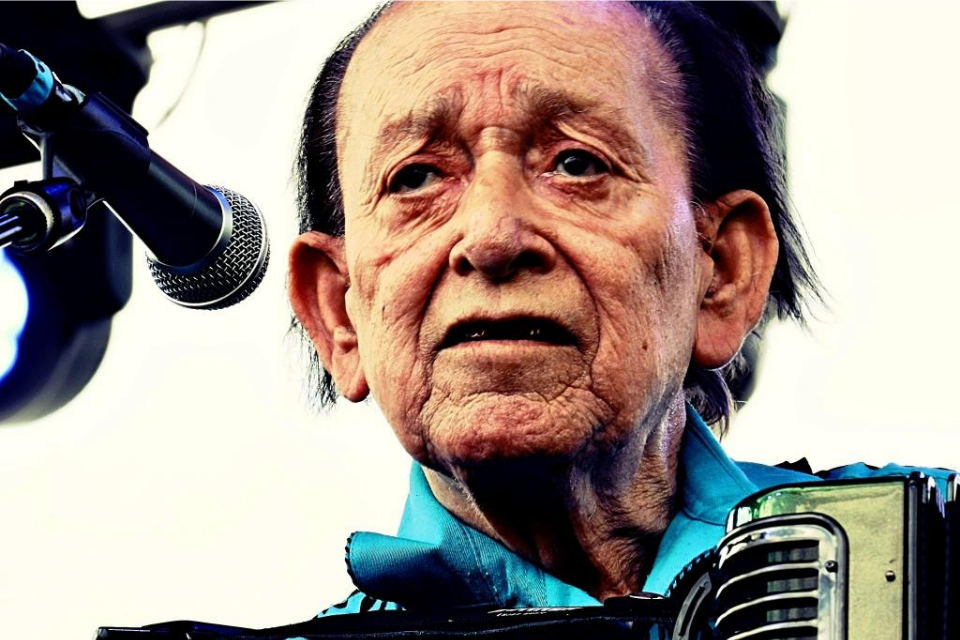
The legendary Flaco Jimenez.

Multi-Grammy-winner Flaco Jimenez of San Antonio joined his old friend Max Baca and Los Texmaniacs for a crowd-rousing rendition of the Texas Tornadoes’ “Who Were You Thinkin’ Of?” Mandolin legend Peter Rowan sat in for several numbers with the ensemble and later played a full set with Los Texmaniacs under the name of Peter Rowan’s Free Mexican Airforce. The Airforce earned rousing applause with a sweet and heartfelt version of the Rowan/Jerry Garcia classic “Moonlight Midnight.” (And by the way, it was Los Texmaniacs with guest guitarist Will Owen Gage who cranked out the “Foxy Lady” of the riddle.)

Rolling Stone calls American Aquarium leader B.J. Barham a “Southern Springsteen.” The songs he performed at Old Settler’s didn’t live up to that billing. His vocals do, however, recall his idol Tom Petty, and the band (including bassist Alden Heges, top photo) has some Heartbreakers-worthy chops. Aquarium fans must be happy that Barham stopped drinking, as that’s a major driver of his songwriting. It seemed at least half the songs in the set dealt with the travails and triumphs of sobriety, and lyrics like these (from 2020’s “The Long Haul”) are decidedly un-Springteenish: “See the hardest part/Of getting sober/Is learning a drinking buddy/Ain’t the same thing as a friend.”

Recommended, and not:

  • Two artists I knew little or nothing about beforehand but enjoyed enough to look forward to seeing again: Maggie Belle, a wonderful singer from New Orleans whose voice has a lot of Amy Winehouse touches; and Sierra Hull, once a tiny mandolin wunderkind, now a thoughtful 25-year-old singer-songwriter with a tight backing band and still-wicked mandolin chops.
  • I knew the California Honeydrops were a good band when I first saw them at the High Sierra Music Festival back in 2016. They’ve matured since: more fun, better songwriting, better performances. They put out a highly danceable funky, bluesy, horns-y mixture.
  • McCoury is a bluegrass legend, and his family band is tight and top-notch. But McCoury’s high, nasal vocals grate my brain like an icy shower or a whiff of strong ammonia.
  • Austin blues guitarist Zach Person is obviously talented, but the bass and rhythm guitar backing track that accompanied Person and his drummer detracted decidedly from his show.

Keeping with Old Settler’s tradition, Austin’s own Shinyribs played the final set on Sunday afternoon to close down the festival. Mic in hand, front man Kevin Russell sashayed through the crowd, dancing with the ladies, singing Freddy Fender’s “Wasted Days and Wasted Nights.”

That’s a great song, and Shinyribs rocked it, but it certainly didn’t describe the exciting days and enchanted nights I spent at Old Settler’s 2022. Something like Robert Earl Keen’s “Feelin’ Good Again” would have been a much better match.

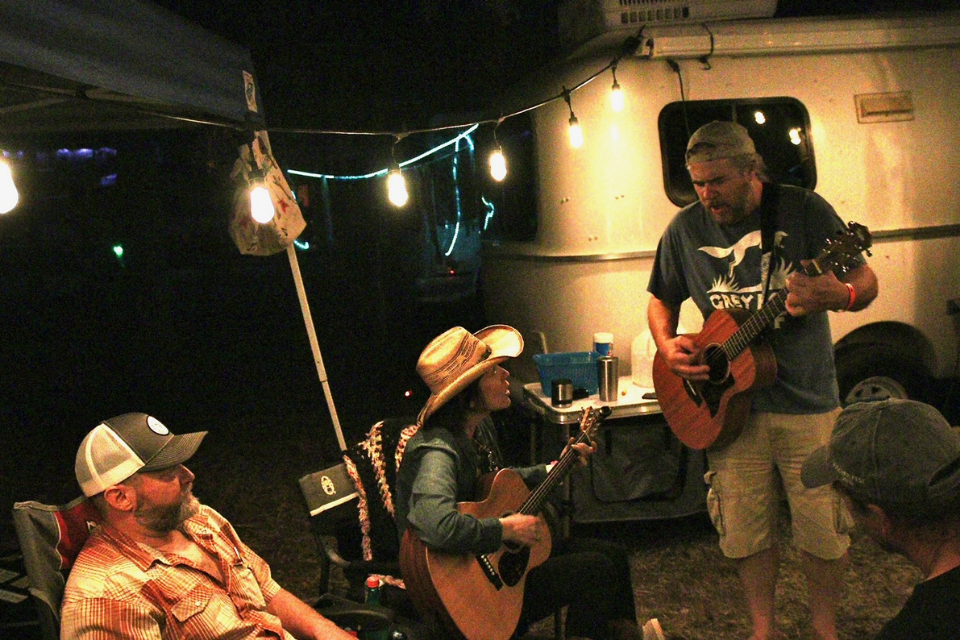
Old Settler’s Music Festival day 1, after dark: When the music stops … it doesn’t

(Originally published April 24, 2020, at Ear Traffic ATX)

(CAMP BANJO, TILMON, TEXAS) – New Orleans-based chanteuse Maggie Belle crooned her last note close to midnight on the opening day of the 2022 Old Settler’s Music Festival. The lights went down, her five-piece band began packing up their gear, and the audience began to drift away.

Many in the crowd didn’t have far to go. The stage is tucked among the cedar and mesquite in a corner of the festival’s liveliest campground. And one of the event’s chief attractions — which, at least once in the past, has been an early showcase for future music superstars — was just about to begin.

“It’s what I come for,” said one smiling, toe-tapping middle-aged lady.

Across the crowded venue, jam sessions popped up and blossomed like the desert after a downpour. Guitars, banjos, dobros, mandolins, fiddles – just about every kind of wooden instrument whose strings can be plucked, picked, strummed, or bowed – appeared from cases and tents.

Traditional folk songs and blues numbers dominated the playlists under the stars. But this writer heard more than a few acoustic Grateful Dead covers and even a rendition of the Rolling Stones’ “Dead Flowers.” The honor of choosing the next song proceeded in an unwritten but genial code, a round-robin among the players.

Each gathering seemed to coalesce into a similar configuration. The busiest artists, those who led the way through every tune, sat or stood in the center. Next came a sprinkling of background vocalists and musicians who contributed quietly or offered up just the occasional flourish. Tapping, nodding, and swaying spectators made up the outer ring. Wandering strangers received warm welcomes.

Every available open space in Camp Banjo — said to be three-and-a-half acres, but it seemed bigger — was occupied by everything from immense RVs to classic, silver Airstreams to simple tents.

Campers had obviously made meticulous preparations for their spaces. They strung up tie-dye and mandala tapestries to create billowing walls. They decorated their sites with banners and streamers, rugs, couches, tables, blinky lights, and even a pair of hanging geranium pots. Grills and camp stoves produced late-night snacks or waited to sizzle bacon, sausage, potatoes, and eggs for tomorrow’s breakfast.

Lee Thompson, a guitar player formerly from Austin now living in Oregon, is a longtime Old Settler. The after-hours camaraderie is an important part of making the festival what it is, he says.

“Some people need music. They don’t want to make money at it, but they need it in a deep way,” Thompson told me the next morning. “They just want to be around people who also need that. And you find ’em here. It kind of boils the fat away. If you really want to play music, come do it here.”

The quality of the campground talent varies tremendously, from earnest novice to true virtuoso. The family-friendly festival has always attracted young players with obviously bright futures.

Thompson recounted a memory from the second Old Settler’s Festival in 1988. “A family came out of their tent, they had some coffee with me and then two little kids came out, 12 and 14,” he said. “One had a fiddle; one had a banjo. They tuned up and then just started ripping.”

Not many years later, those two sisters, Emily and Martie Erwin, became known as the founding members of the Dixie Chicks, now known as the Chicks.

“You can’t bottle it,” Lee’s brother Jay Thompson, of Dallas, says of the campground mystique. “It’s got its own flavor.”

This writer fell asleep well after 2 am, listening to the Thompsons and their friends, plus a few other groups of pickers in the immediate neighborhood.

It was beginning to grow light when I lifted my head from my pillow. Somewhere not far away, I heard one lonely guitar competing with a crowing rooster to welcome the dawn.

Wednesday, March 30, 2022

Neal Francis Leaves ‘Em Gasping for More


Neal Francis left Chicago, and he headed to the ATX. Three days, 6 concerts, and 2 live radio shows later, Francis moved on. The modern day piano man left behind a legion of new fans begging him to come back soon.

During his whirlwind SXSW 2022 stay, Francis appeared at venues as large as Willie Nelson’s Luck Reunion and as intimate the brand new coffee bar at the Carpenter Hotel. He shared bills with the likes of Nelson, Jason Isbell, Heartless Bastards, and The Bright Light Social Hour. His high energy shows left audiences hungry for more.

“I think he’s really going to blow up,” predicted one fan, who told me he’d been to half of Francis’ Austin appearances.

This writer was fortunate enough to catch Francis and his band under a big tent at Luck Reunion on Thursday and squeezed into the patio stage at Parlor & Yard on Saturday. Both times, the quartet delivered incredibly tight arrangements with enough jamming to show off their virtuosity. They play a little bit of soul, a little bit of synth, a little bit of funk, and a lot of rock and roll. It’s all packaged around Francis’ soft but intense tenor sharing lyrics that explore the 30-year-old’s battles with alcohol, drug addiction, and their accompanying sorrows.

Witness this line from the hard charging “Can’t Stop the Rain,” off of his new album, In Plain Sight. (The album cut includes some fine slide guitar work by Derek Trucks.)

When you look in the mirror,

Do you see someone you know? 

Or are you just a stranger,

Buried in the snow?

Francis’ style touches on, but certainly doesn’t imitate, many keyboard legends. Going from song to song, his music elicited a “that sounds kind of like” response in my head: one was kind of like Elton John, another was kind of like Sly Stone, kind of like Leon Russell, kind of like Phish’s Page McConnell. The press clippings about his 2019 debut album, Changes, include a BBC radio host calling Francis “the reincarnation of Allen Toussaint.” One of the photos I took even made me think he looked kind of like a young Warren Zevon, whose demons he shares.

After the Parlor & Yard show, I asked Francis who his favorite piano player is. Given his variegated musical influences, his response really came as no surprise. He glanced upward for a moment then told me, in all sincerity, “I, I don’t really think I can answer that.”


Friday, February 18, 2022

I Wish I Could


I wish I could throw like Nelson Mandela and sing like Michelangelo;
I wish I could blow like Lucille Ball and free like the mad Karl Rove;
But, mostly, I just wish I could talk like Johnny Cash.

I wish I could scheme like Mazeroski and speak like the Big Man;
I wish I could scream like Frank Sinatra and swing like Julius Caesar;
But, honestly, I just wish I could talk like Johnny Cash.

I wish I could field like Lindsay Vonn and act like Barbara Jordan;
I wish I could waltz like Pablo Picasso and rule like Justin Tucker;
But, actually, I wish I could talk like Johnny Cash.

I wish I could pound like Mario Lemieux and draw like Meryl Streep;
I wish I could win like Mother Teresa and laugh like Keith Moon;
But, most sincerely, I wish I could talk like Johnny Cash.

I wish I could shoot like Fred Astair and serve like Michael Jordan;
I wish I could think like Jerry Garcia and fly like Babe Ruth;
But, humbly, I want to talk like Johnny Cash.

I wish I could skate like Patrick Mahomes and joke like Albert Einstein;
I wish I could paint like Mavis Staples and kick like Tom Brady;
But, for real, I oughta be able to talk like Johnny Cash.

I wish I could write like Jesse Owens and survive like Carol Burnet;
I wish I could run like Vonnegut and pick like Bill Clinton;
But, don’t you think, wouldn’t it be great if I could talk like Johnny Cash?

I never wanted to dance like Rick Perry or Tom DeLay or Sean Spicer;
And I'm glad I don’t lie like Donald Trump or Richard Nixon;
But I really sue-ly do-ly, honestly and truly, wish I could talk sonorous and deep and big, talk just like Johnny Cash.

“How do you do?”

Photo by Heinrich Klaffs/Creative Commons license

The Brits


Names in British novels. 

So novel.

So British.

So mocking.

So true.


Bathsheba Everdene;

Uncle Pumblechook;

Lord Frederick Verisopht;

Henleigh Mallinger Grandcourt;

The Aged Parent;

Sir Damask Monogram.


Each, alone, evokes all appearance, all nature. Then, hundreds of pages to prove it.


A new classic British novel in five names:

Griselda of Xebec,

Sir S.K. “Silky” Pocketsquare,

Lord George Piggly-Wiggly,

King Kermit Orion Neville Gaitherslather (KONG),

Twitters McRobin.


Save me the trouble.

Fill in the proof.


Eye Fly


My pet fly lives in my eye. Loyal, true, and obedient. So well trained. He (my bias; he may be she) goes where I gaze. Up, down, in, out.

He flies around the room and back on my command. Today, when I brushed N’s teeth, I flew him in and out of N’s mouth and up his nose. 

If I forget who he is, I swat him on my food or flying in the door. I swat air.

Sometimes, he startles me. More than sometimes.

Slowly, day by day, he melts away. Soon he will be gone.

I will miss him.


HE'S BACK!!! FOREVER!


Monday, August 3, 2020

Eulogy For a Great Man

“Great” – like “quality” – is a tough word to pin down. We think we know greatness when we see it, but frequently struggle to explain our rationale. A friend of mine passed away last week after a two-plus-year fight against an insidious brain tumor. 

Although he had his flaws, Lou Goodman was a great man. 

There. I said it. Now here’s where I explain, mostly to myself, why I think so.

What is “great”? It’s related to “good,” but not part of the good-better-best triad. It has no natural antonym, like “bad” is to “good.” Merriam-Webster has 11 definitions for “great” as an adjective; it means everything from “large in size” to a more-distant relative. As for what qualities make a person great, three of those definitions stand out:

  • Eminent or distinguished;
  • Markedly superior in character or quality; and
  • Remarkably skilled.

So many parts of Lou’s professional career match up with those three standards of greatness. As the CEO of the Texas Medical Association for 22 years, Lou was “eminent and distinguished” – he stood out – among his peers around the nation. The more experienced among them quickly recognized Lou’s talents and gladly let him lead. The newcomers forged his alliance. A generation of health care leaders sought his wisdom, trusted his counsel, and followed his example. The physicians whom he so greatly admired and for whom he toiled so mightily in turn held Lou in the highest esteem.

Though Lou was known to use bluff and bluster to his advantage, he had a lot of there there. No doubt about his “markedly superior qualities.” Lou was very smart (he earned A-plusses, not just As, in graduate school), a quick study on the complex issues medicine faces. He demanded solid analytics because that’s how he earned his PhD and then built his career. He respected those of a similar ilk. He saw right through lightweights and blowhards. Lou wouldn’t suffer a fool, and many a fool suffered his disdain.

When it comes to “remarkable skills,” I believe each of us has at least a bit of greatness within. It may seem insignificant. My mom, for some reason, always prided herself on how well she folded hospital corners in a bed sheet. Others’ great skills may be more easily quantified and recognized, even if limited in scope – hitting a baseball, blowing a horn, writing elegant code, discerning a muffled heart murmur. 

But it’s the breadth, the sheer area, of competencies in which someone is “remarkably skilled” that makes us brand a woman or a man as great. Such was Lou Goodman.

Lou was a great leader. The volume of books and research on leadership testifies to the expanse of skills the best leaders must master: personality, strategy, attitude, fortitude, confidence, humility, patience, vision.

I’ve seen Lou expertly ride the often choppy waves of each of those character traits ... except humility. I’ll leave it to his family and closer friends to disclose if Lou was humble in private. He certainly was a proud man – the opposite of humble – but I’d argue that pride fueled his drive for success. Not only did he hate to lose; he hated to be seen as a loser. Even absent humility, he was still a great leader. None of us – even the pantheon of bests like Lincoln and Churchill that Lou so admired – is perfect.

Lou made few mistakes, and his pride made him loath to admit them. I heard him acknowledge one or two, punctuated with the advice/warning, “Don’t ever make the same mistake twice.”

Lou could read people amazingly quickly – and usually quite accurately. He could tell friend from foe, genuine from poser, clean from dirty, valuable from timewaster, trustworthy from dodgy. This skill fed Lou’s ultimate strength: he was a master at forging long-lasting, tight relationships. So many of his friends were besties. So many associates were confidants.

At the ceremony last year to rename the TMA building after Lou, a U.S. congressman and a state senator were the keynote speakers, earnestly laying on the praise. Between them, they had more than 40 years of public service. They were close enough that Lou could call them any day for advice, and they were close enough that they frequently called him for advice.

Lou didn’t ask for favors; he convinced you it was in your best interest to do what he wanted. And then he returned the help. It was cement. Neither felt put out. Each anticipated the next opportunity to help.

If you don’t know about TMA, it’s the state professional organization that represents more than 53,000 Texas physicians and medical students. Been around since 1853. Lou regularly reminded us, “this is the doctors’ organization. They are the ranchers, we’re the ranch hands.” This simultaneously empowered and protected Lou and the people like me who worked for him. The physicians set the policy objectives, but we were trusted to use our own ideas and skills to get us there. It made TMA a great place to work, enabled Lou to hire some absolutely outstanding men and women, and kept many of them working for the doctors for 20, 25, 30 years or more. He loved to put his best staff on the spot, knowing they’d perform well, giving them a chance to shine in front of others.

Lou enjoyed a good argument, especially one-on-one, across the desk or standing in a quiet corner. Extra points for $5 words and historical references. He gave staff the latitude to disagree with him, to make our case, to use the expertise that he knew we had and he didn’t. (That’s why he hired us.) They weren’t always resolved right away. Some went on for months, with frequent jibes and other reminders of the unsettled business. On most questions of any import, one of us would end up agreeing with the other, or we’d devise an even better solution together. “You do know who signs your paycheck, don’t you?” was usually bluster – but a not-so-subtle reminder. Very, very rarely did Lou play his “because I’m the boss” card.

And Lou Goodman was a good man. Maybe not a boy scout – he could be stubborn and he had his prejudices – but he was honest and kind, sincere, a loyal friend. Several times I recall we undertook the tedious process of evaluating each of TMA’s numerous programs and projects and services, looking to trim those that were no longer needed. When it came down to it, though, Lou couldn’t pull the trigger. “Programs are people,” he’d say.

It’s been odd these past two years as we saw less and less of Lou, as we had less and less of him. And now he’s gone. But not. I hear so many of my colleagues speak a Lou-ism or lay out a Lou-like plan or tackle adversity with Lou-ish gusto and determination. 

We have a new boss now. He inherited an excellent team. And amid the unexpected challenges of COVID-19, he led us and motivated us to be everything that Lou saw in us, to give everything that Lou trained us to give.

And, so, the final defining trait of a great person – a legacy. Check.

Lou Goodman was a great man. Per that Texan-ism that Jersey Lou adopted, “It ain’t braggin’ if it’s true.”